Case study

Creating an engaging, age-appropriate digital health experience for teens

10/12/2025
Teenage girl on phone
Share this study:

Background

Teenagers have distinct and well-documented developmental, behavioural, and healthcare needs that are often overlooked in healthcare environments [1], and many clinical trials face challenges in recruiting and retaining teenagers.

We recognised an unmet need to better support young people, aged 13 to 19, who experience healthcare procedures or participate in clinical trials. In this project, our goal was to understand the type of support that teenagers want and determine how we could deliver it in a way that felt appropriate, engaging, and relevant to their experiences. 

Challenges

Engagement with co-design

To effectively work with teenagers as co-designers, we needed to facilitate engagement in a way that would ensure we genuinely represent their needs.

Accounting for diversity

Within this age group there is wide variation in maturity, confidence, healthcare experience and digital behaviour. We needed to account for this diversity in our approach.

Our approach

To determine how we could meaningfully support teenagers, we undertook a three-phase research and co-design project to: 

1) Build understanding

To establish a baseline understanding of the challenges teens face in healthcare and clinical trial settings, we combined secondary research with interviews involving 20 adults who work with or care for teens, including healthcare professionals, research site staff, teachers, and caregivers. 

2) Co-create with the Little Journey Youth Committee

We partnered with five young people aged 13–19 to co-design a digital solution shaped by their needs and preferences. This phase blended 1:1 sessions, group workshops, and take-home activities that allowed them to contribute ideas at their own pace. 

3) Evaluate and refine

To refine the emerging concepts, we gathered feedback from an additional 20 teens through hospital visit sessions and in-depth online interviews, helping us strengthen and validate the final direction.

A cute looking cartoon mountain with a flag in the top.

Our solution

This work highlighted five key needs that shaped the design direction.

The need

Provide independent access to trustworthy information


In line with secondary research [2], all teens we engaged with during hospital visits, online feedback sessions, and within the Youth Committee, had their own phone. While caregivers often approve app downloads for younger users, teens expect to be able to access healthcare information privately.

Many used TikTok, the NHS website, and Reddit for health information.   

Our response

User profiles


We enabled teenagers to download a teen version of their Little Journey app while maintaining caregiver access to a corresponding caregiver version

Beyond these technical changes, the teenagers' appetite for information from trustworthy and relatable sources shaped our approach to developing teen-focused content. We provided access to answers to questions frequently asked by teens undergoing the same procedures.  

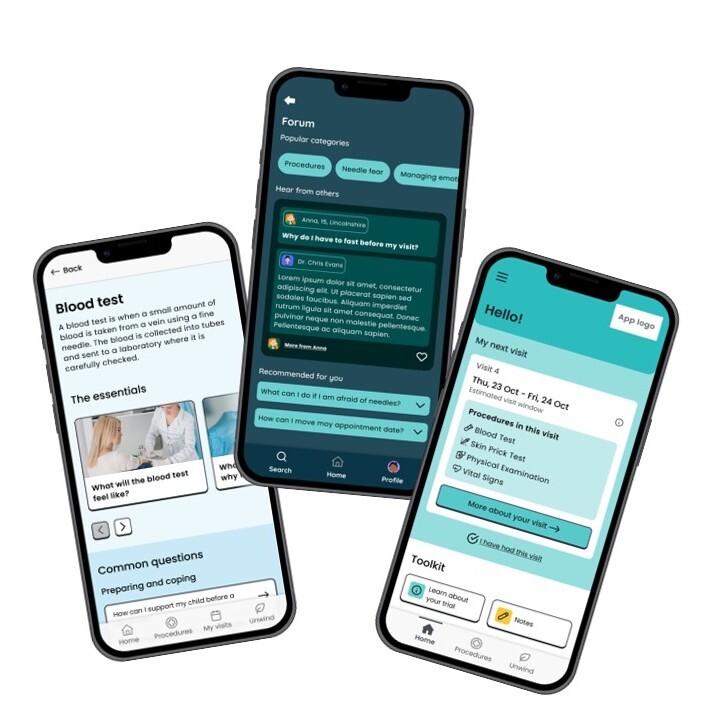
Screens showing teenager user profile selection and FAQs about blood tests
The need

Design to empower and include, don't patronise

Bright colours, cartoon-style illustrations, and simplified language which appeal to younger children were seen as patronising by some teenage users. These elements acted as barriers to engaging with content rather than enablers.

"Be supportive, but don’t sugar coat it.”


Our response

Teen-specific user interface


Through multiple co-design sessions and hospital visits, teens helped us shape a completely new look and feel. Together we explored what language and level of detail felt appropriate for their age.

The result is a new visual identity and tone that retains Little Journey’s accessible and supportive feel, while being age-appropriate for teens.

Screens showing the user interface for teenagers on the homepage and unwind area
The need

Provide the essentials, then allow exploration

Teens wanted clear and factual information about procedures: why they were having the procedure, and what to expect before, during, and after.

For some, that was enough. Others wanted to go deeper, exploring how procedures work, reading tips from peers, or accessing reassurance from healthcare professionals. 

"Sometimes you don't know what you need to learn until you hear other people's questions."


Our response

Simplified navigation with layered information

To give everyone the foundational information and support independent learning for teens who wanted to dive into more details, we simplified the navigation so priority information is available within a few clicks of the home screen.

Procedure pages were also restructured to reflect teen priorities, presenting: 

  • One sentence summary of the procedure
  • Quick 'essentials' sections addressing key questions
  • Common questions from other users
  • Visuals of the equipment they will encounter 

This layered approach supports both quick learning and deeper exploration. 

Teens Layered information
The need

Building confidence in interactions with healthcare professionals

Many teens described feeling nervous, forgetful or overwhelmed during appointments. They valued tools that could make clinical interactions more predictable and collaborative.

They were particularly interested in features that allowed them to prepare questions in advance and privately explore topics that felt personal or embarrassing.


Our response

FAQs & Notes

We ensured the app includes access to frequently asked questions and a notes feature that helps teens plan what they want to discuss with their healthcare team.

This supports more confident and direct communication with healthcare professionals. It also takes the pressure off preparing for each appointment, as teenagers can note anything important i.e. symptoms as they happen between visits.


Teens Notes & FAQs
The need

Support in planning appointments

While not raised as a specific need, the desire to plan and prepare emerged repeatedly in teens’ proposed solutions, such as calendars, notes and checklists.

This aligns with our wider research [3] and preparatory interviews, which highlighted that while adolescents value independence and control, they may also need support with executive function.


Our response

My Next Visit for teens

Building on a feature we had already developed for caregivers, we introduced a teen-facing My Next Visit module that provides the information teenagers prioritise when preparing for appointments. The priority of the information shown differs for teen vs. caregiver users to better meet their differing needs.

This helps them take ownership of their healthcare experience without overwhelming them with content better suited to caregivers. 

Example screens showing the differences between My Next Visit for teens and My Next Visit for caregivers

Outcomes

[Overview of the outcomes. Rearrange the cards below as needed!]

speech marks

Being able to build ideas and actually see some kind of result was very satisfying and honestly fun

Teenage Co-designer

Little Journey Youth Committee

speech marks

If you know that it's a trusted answer that's also nice, because they could get some answers from like Wikipedia or something, which isn't very trustworthy and you don't really know if it's safe

14-year-old commenting on the value of being able to access trusted information via Little Journey

 
Teenage boy using a smart phone and wearing headphones

100% of teenagers interviewed after the design changes said the new design is age-appropriate

Light Bulb-1

Over 20 hours spent co-creating with teens

Designing with adolescents rather than for them has reshaped the way we think about digital health experiences. By combining evidence-based psychological insight with genuine co-design, we have created a solution that reflects the realities of teenage users while supporting the clinical, emotional and behavioural outcomes that matter most. This project demonstrates our commitment to understanding the needs of all patients and delivering digital experiences that are both clinically robust and human-centred. As we continue to build on this work, our goal remains clear: to empower young people to engage confidently with their healthcare and ensure the solution we develop truly meets them where they are.

A dark blue flip calendar icon

Book a Demo

Book a capabilities call and see how Little Journey can support your next paediatric clinical trial.

Share this study:

You may also like...

Placeholder
Case study

[Case study title]

[Summary of the case study, preferably a simplified version of the background or problem]

Placeholder
Case study

[Case study title]

[Summary of the case study, preferably a simplified version of the background or problem]

Placeholder
Case study

[Case study title]

[Summary of the case study, preferably a simplified version of the background or problem]