Case study
Engaging and retaining teenagers in clinical research

Key Results
156.5 hours
total engagement with teenagers for this project
5 co-design partners
collaborating over four months
27 evaluators
taking part online and in pop-up co-design sessions
100% approval
all teens agreed the new design was age-appropriate
Background
This case study shows how we worked with teenagers to understand what builds trust, relevance and sustained engagement - then translated those insights into Trial Flow features that support participation in clinical research.
Challenges
The adolescence gap
Adolescence is a distinct developmental, emotional and contextual stage. Yet teenagers are often added into adult or paediatric trials without the experience being designed around their realities.
Engagement with co-design
To effectively work with teenagers as co-designers, we needed to facilitate engagement in a way that would ensure we genuinely represent their needs.
Accounting for diversity
Within this age group there is wide variation in maturity, confidence, healthcare experience and digital behaviour. We needed to account for this diversity in our approach.
Our approach
We used a multi-phase participatory design process, combining developmental and psychological research with sustained co-design.
The work included:
-
Secondary research into adolescent development and healthcare needs
-
Interviews with caregivers, healthcare professionals and teachers
-
A four-month co-design partnership with five teenagers
-
Pop-up co-design in NHS primary care settings
-
Online evaluations with additional teenagers
A key learning was that the way we engage teenagers in design is inseparable from the way we design support for them. The same conditions needed for effective co-design — trust, relevance, predictability and flexibility — are also prerequisites for teenage engagement in clinical research.

Our solution
The principles that shaped the solution
Trust
Trust had to be earned through honest, direct information from authoritative sources. Teenagers wanted support that was clear and reassuring without being patronising.
Flexibility
Teenagers’ capacity and motivation can fluctuate week to week. The solution needed to allow users to skim, explore, return later or engage in short bursts.
Relevance
If an experience does not feel like it is “for me,” teenage engagement may never begin. Visual design, tone and content needed to feel age-appropriate, serious and respectful.
Predictability
Teenagers wanted to know what would happen, when, where and why. Predictable structure helps reduce anxiety and build confidence.
Supporting the caregiver <> teen <> healthcare professional relationship
Teenagers wanted independent access to information and help being able to talk to healthcare professionals. But they still wanted to know their parents/caregivers could access key content too. The solution needed to support autonomy without shifting responsibility fully onto the teenager.
Translating these principles into effective and engaging support for teens
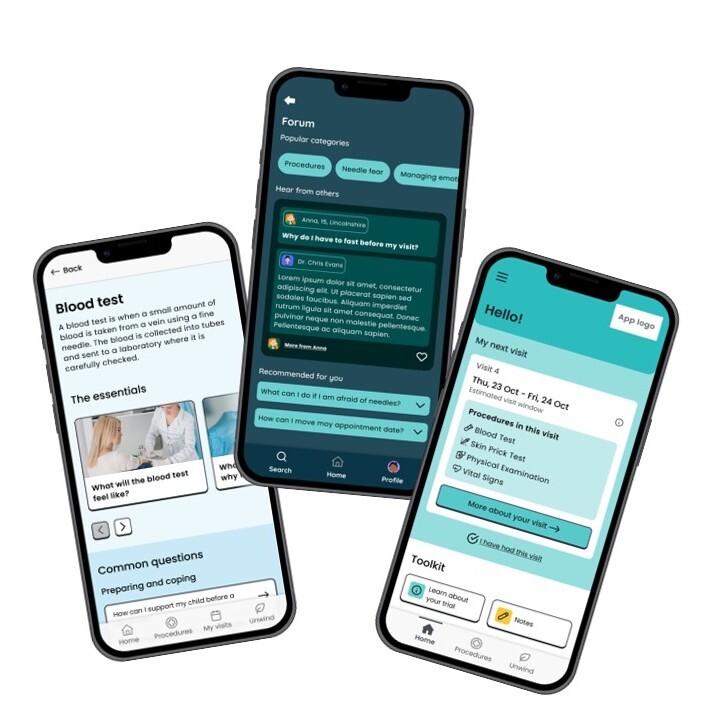
Teen and caregiver profiles
Teenagers can access information independently, while caregivers retain access to key support.
Teen-specific visual identity and tone
The experience retains warmth and accessibility without feeling childish or patronising.
Layered information
Priority information is easy to find, with opportunities to go deeper through FAQs, peer questions and procedure-specific detail.
FAQs and notes
Teenagers can prepare questions, capture concerns and feel more confident speaking with healthcare professionals.
My Next Visit for teens
Visit preparation is tailored to what teenagers prioritise, supporting autonomy while reducing overwhelm.

Outcomes
Reusable approach
That can be applied across therapy areas, helping Trial Flow better support specific patient populations in clinical research.
Age appropriate design
100% of teenagers interviewed after the design changes said it was relevant for them.
Being able to build ideas and actually see some kind of result was very satisfying and honestly fun.
Teenage co-design partner
[Overview of the outcomes. Rearrange the cards below as needed!]
You may also like...
Case study
[Case study title]
[Summary of the case study, preferably a simplified version of the background or problem]
Case study
[Case study title]
[Summary of the case study, preferably a simplified version of the background or problem]
Case study
[Case study title]
[Summary of the case study, preferably a simplified version of the background or problem]
.png?width=1500&height=1500&name=Trial%20Flow%20Phone%20(Left).png)